
VidRush
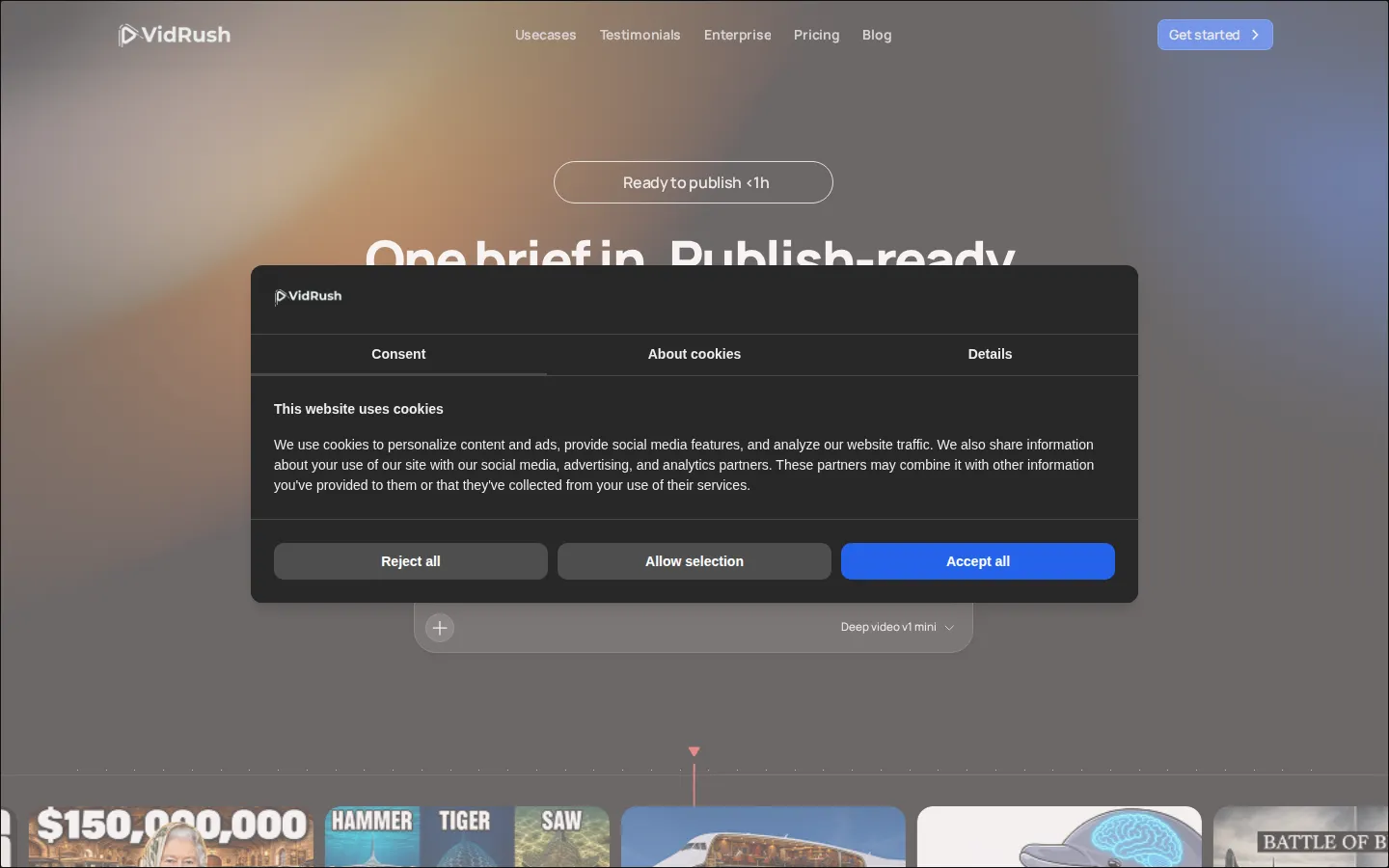
VidRush is an AI video generation platform for long-form content. It takes a single brief and produces researched, scripted, narrated, and edited videos matched with real footage, ready to publish in under an hour. Used by 100K+ creators for documentaries, explainers, breakdowns, and listicles, with credit-based plans starting at $99/month.
What is VidRush?
VidRush is an AI long-form video generator that produces publish-ready videos from a single brief in under an hour. Unlike short-form AI clippers, VidRush targets long-form formats such as documentaries, explainers, breakdowns, and listicle top-10 videos that normally take a production team days to create. The platform's workflow is fully automated: every video is researched from primary sources, scripted, narrated with AI voiceovers, edited with pacing and structure, and matched to real footage sourced from across the web rather than AI-generated stock clips. VidRush explicitly avoids template slop, building each video from scratch so that channels in its showcase run entirely on the platform. The built-in editor lets creators refine the result, and support agents are available around the clock. The platform claims to get users about 80% of the way to a finished video, with the editor handling the final polish. VidRush targets YouTube creators and media businesses that need consistent long-form output, including documentary channels, finance and business explainers, automotive breakdowns, product reviews, and ranked listicles. Pricing is credit-based with plans from $99 per month for 2,000 credits and up to 6 videos, scaling to 18,000 credits on the Pro plan, with yearly billing saving 20%. Per finished minute, costs range from about $1.93 to $2.72 depending on the plan, compared with $50-$150 per video for freelance editors. VidRush is built by Vidrush AI Studios and markets itself as the equivalent of having a senior editor, motion designer, and scriptwriter on demand, trusted by more than 100,000 creators. VidRush's enterprise offering covers teams that need dedicated support, higher volume, and brand-specific video styles, and its showcase channels demonstrate real-world output across documentary, explainer, breakdown, and listicle formats. The platform's FAQ addresses the quality question directly, explaining that every video is researched, scripted, narrated, and edited from scratch, then matched to real footage sourced from across the web, with no templates and no AI-generated footage. The built-in editor handles the remaining 20% of polish, and support is available around the clock via in-app chat with most issues resolved within hours. VidRush also runs a blog with content on long-form video strategy. The credit system is straightforward: plans include monthly credits, video counts, team seats, and concurrent generations, with per-minute costs dropping as you scale, making the economics favorable for channels publishing multiple videos per month.
VidRush Core Features
Brief-to-video pipeline
One brief becomes a researched, scripted, narrated, and edited video in under an hour.
Long-form formats
Purpose-built for documentaries, explainers, breakdowns, and listicles.
Real footage sourcing
Videos are matched with real footage from across the web, not AI-generated clips.
AI research & scripting
Content is researched from primary sources with retention-focused structure.
AI narration
Natural voiceovers generated from the script automatically.
Built-in editor
Refine pacing, visuals, and narration after generation.
Credit-based pricing
Plans from $99/month with per-minute costs from $1.93.
24/7 support
Live chat with support agents resolving issues within hours.
Who is VidRush for?
VidRush is built for creators and media businesses that publish long-form video consistently. YouTube documentary channels use it to produce deep dives on history, psychology, true stories, and disasters from primary sources. Finance and business channels create explainers with charts, on-screen text, and retention-focused pacing. Automotive and tech reviewers produce breakdowns with technical b-roll and per-item stats. Listicle and top-10 channels generate ranked roundups with fast pacing and clear payoffs. Content agencies use it to scale video production across client channels without hiring editors. Podcasters and media companies repurpose research into video formats. Educational channels produce course-style explainers. Faceless channels benefit from AI narration and sourced footage. Solo creators who want to publish multiple videos per week use it to replace a production team. Marketers use long-form video for brand storytelling and thought leadership. Teams with an editorial calendar use the brief-driven workflow to keep output consistent. VidRush also suits creators transitioning from short-form who want to enter long-form without the production overhead. Anyone who needs researched, narrated, edited long-form video at scale, from hobbyist channels to professional media houses, is the target audience, with enterprise support available for larger operations. Media production companies use VidRush to fulfill long-form content contracts without scaling headcount. Brand teams produce thought-leadership and storytelling videos for corporate channels. History and education channels maintain weekly publishing schedules. News-adjacent channels create explainer segments on current topics. Video SEO consultants use the platform to build content libraries that drive search traffic. Startup founders tell their company stories in documentary style. Podcast networks turn episodes into visually rich long-form videos. The 24/7 support and enterprise options make it viable for professional operations that cannot tolerate production downtime.
VidRush Use Cases
Produce documentary deep dives on history and true stories for YouTube.
Create finance and business explainers with charts and on-screen text.
Build automotive breakdowns and product reviews with technical b-roll.
Generate ranked top-10 and listicle videos with fast pacing.
Scale client content production for agencies and media houses.
Turn research reports into narrated educational videos.
Launch a faceless channel with consistent AI-narrated long-form output.
VidRush Pros and Cons
Pros
- Full long-form production automated from a single brief.
- Real footage sourcing avoids the AI-slop look of template videos.
- Dramatically cheaper and faster than freelance editing.
- Credit plans scale from 6 to 56 videos per month.
Cons
- Pricing starts at $99/month, which is steep for casual creators.
- Output is about 80% finished, so editorial polish is still needed.
- Less manual control than traditional video editing software.
FAQ About VidRush
VidRush Pricing
Paid, credit-based. Starter $99/mo (2,000 credits, up to 6 videos, 36 min), Creator $239/mo (6,000 credits, 18 videos), Pro $639/mo (18,000 credits, 56 videos). Yearly billing saves 20%; per-minute from $1.93.
Check official pricingStarter
2,000 credits, up to 6 videos, 36 minutes of video, 1 concurrent generation
Creator
6,000 credits, up to 18 videos, 109 minutes, 1 team seat, 2 concurrent generations
Pro
18,000 credits, up to 56 videos, 327 minutes, 3 team seats, 3 concurrent generations
VidRush Alternatives

GPTProto
GPTProto is a global AI API aggregation platform that unifies 200-plus leading models, including Sora, Veo, Kling, Seedance, GPT-5.6, Claude, and Gemini, behind one OpenAI-style key and one shared balance. It charges zero platform fees with free fallback and routing, offers pay-as-you-go top-ups with recharge bonuses, and also provides AI image and video tools. GPTProto suits developers, startups, and enterprises building AI applications across text, vision, speech, and video.

SnapGen AI
SnapGen AI is an AI video generator that converts text prompts and images into short videos using frontier models such as Veo 3.1, Kling, and Seedance. It offers a free forever tier, pay-as-you-go credits, an unlimited video plan, and an API, making it suitable for content creators, marketers, and developers who want fast, affordable AI video production without design experience.

Nereo
Nereo helps brands turn product URLs, images, scripts, and virtual presenters into product ads, UGC-style videos, commercial visuals, and try-on assets.