
TinyHumans
TinyHumans builds open-source AI agents for individuals, led by OpenHuman, a personal AI super intelligence that runs as a desktop app on macOS, Windows and Linux. OpenHuman keeps a local-first, encrypted memory of your life, plugs into the apps your work already lives in, and orchestrates fleets of agents that automate real work. Pricing starts at $19.99/month.
What is TinyHumans?
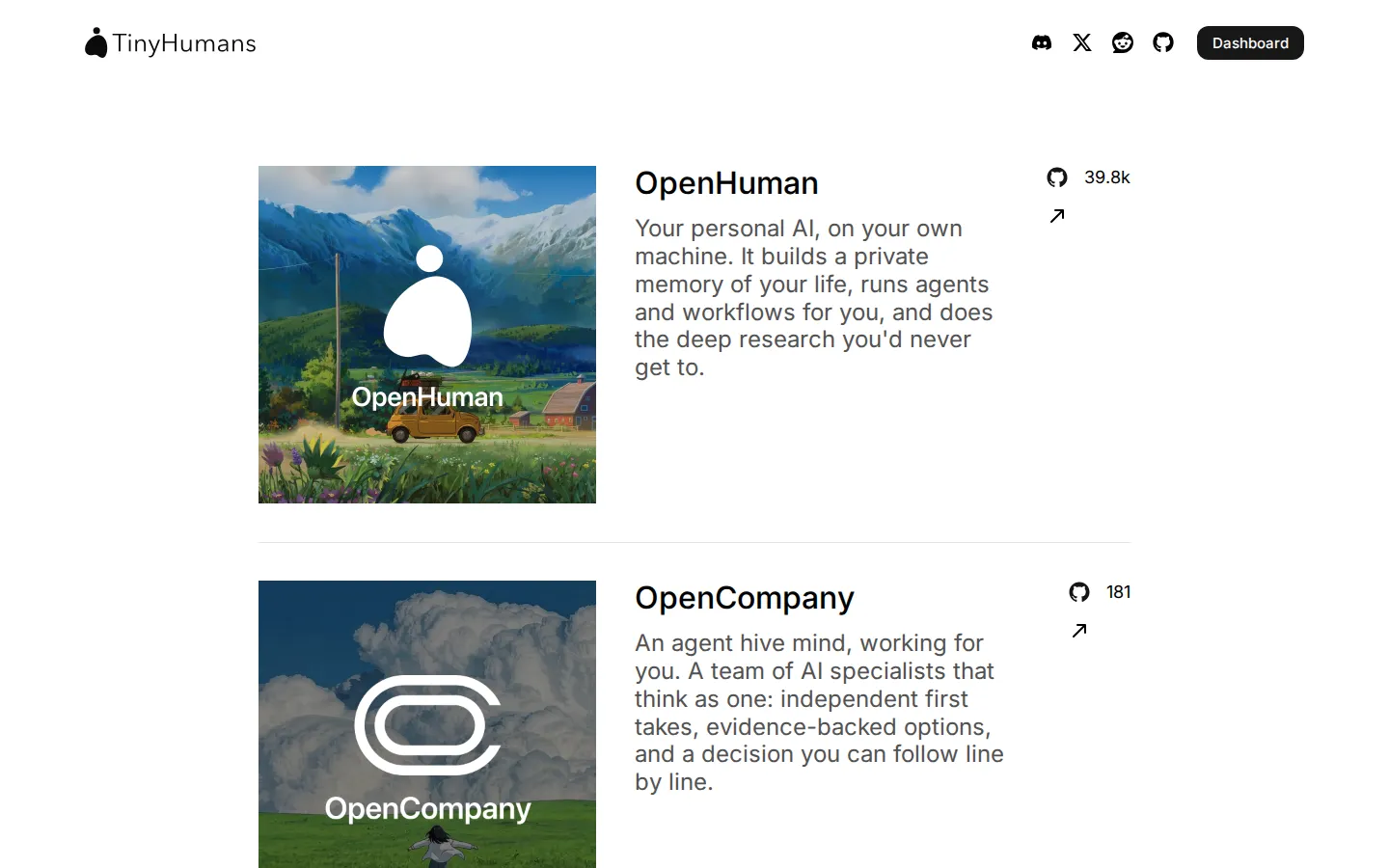
TinyHumans is an AI lab building open source AI agents for one person, with a stated mission to take humans one step closer to AGI. Its flagship product, OpenHuman, is described as your personal AI super intelligence: a brain that builds a local-first memory of your life, a fantastic orchestrator of agent fleets and workflows, and a deep researcher. OpenHuman ships as a native desktop application for macOS, Windows and Linux under the GPL-3 license, so the agent runs on your own machine instead of inside a vendor cloud. Its memory engine decides what to keep, how to compress it, and what surfaces when an agent needs context, building what the company calls a second brain. The workflows engine orchestrates agents to automate whatever you want, from a simple workflow to a complex one with multiple agents and steps. Behind both sits Medulla, the orchestration engine that decides how many agents to spin up, which models to invoke, and how to split and verify the work. OpenHuman plugs into the apps your work already lives in, including Notion, Gmail, Telegram, Slack, Sheets, Excel, Teams and GitHub, and the site says you can connect up to 100 apps, 10,000 MCPs and 90,000 skills through OAuth, MCPs and skills. Community posts on the homepage describe a desktop agent with local encrypted memory, screen awareness and more than a hundred one-click integrations, and one post claims the project reached 32,000+ GitHub stars and 100,000+ users. The GitHub repository for OpenHuman shows about 39.8k stars. TinyHumans lists two sibling projects alongside OpenHuman: OpenCompany, pitched as the operating layer for one-person businesses that lets you run an entire company with a headcount of one using a roster of agents for every function coordinated by one host, and Medulla, also published as its own repository. Pricing sells the hosted side of the stack in credits, with Basic at $19.99 per month and Pro at $199.99 per month, each tier including everything below it plus more credits, and an Enterprise tier for teams with scale, security and compliance needs. You can also top up credits instead of subscribing, with a five dollar minimum and auto-recharge. Documentation lives on GitBook, and the team runs a Discord server, an X account, a subreddit and a GitHub organization.
TinyHumans Core Features
Local-first memory engine builds an encrypted second brain of your life and work
Medulla orchestration engine decides how many agents to spin up and which models to invoke
Workflows engine automates tasks with simple or multi-agent, multi-step automations
Connects up to 100 apps, 10,000 MCPs and 90,000 skills through OAuth and skills
Native desktop app for macOS, Windows and Linux, released under the GPL-3 license
Deep researcher mode digs through your connected tools instead of only chatting
Third-party API access to LLMs, embeddings, voice and OAuth APIs
One dashboard for plans, credit balance and top-ups
Who is TinyHumans for?
TinyHumans positions its agents for individuals, and that framing matters: the homepage headline is open source AI agents for one person, not for a department or an enterprise rollout. The clearest fit is a knowledge worker or operator who already lives across many SaaS tools and wants one agent with real context instead of another chatbot that forgets. It suits people who are uncomfortable handing a vendor full access to their email, notes and files, because OpenHuman runs as a desktop app on macOS, Windows or Linux and builds a local-first memory of your life, described on the homepage as local encrypted memory. It also fits power users and agent enthusiasts who want to orchestrate agent fleets, wire up MCP servers and skills, and automate workflows that a single chat window cannot handle. Founders, freelancers and solo operators are an explicit target as well, since TinyHumans publishes OpenCompany as the operating layer for one-person businesses: a roster of agents for every function, coordinated by one host. Developers and open source advocates get the most leverage, because the code is GPL-3, the flagship repository shows around 39.8k stars, and documentation lives on GitBook with Discord, GitHub, X and Reddit communities behind it. Researchers and analysts fit the deep researcher positioning, letting the agent dig across connected tools instead of merely answering in chat. Privacy-minded and self-hosting-minded users benefit from the desktop architecture, where the work happens on their own machine. It is a poor match for teams that need SSO, compliance paperwork and on-premise deployment today, since those are Enterprise-only and sold through a contact form. Anyone wanting a free product should look elsewhere, because the cheapest plan is $19.99 per month and credit top-ups start at $5. People who only want a lightweight writing assistant may also find a full orchestration stack heavier than they need. If you want a personal agent that learns you quickly, remembers across your tools and stays under your control, TinyHumans is squarely aimed at you.
TinyHumans Use Cases
Replace a pile of SaaS assistants with one agent that knows your context
Run a one-person business using OpenCompany's roster of agents for every function
Automate recurring reporting and updates across Gmail, Sheets, Slack and Notion
Research topics deeply across your own documents and connected apps
Keep a private, local-first archive of notes, decisions and conversations
Coordinate multi-step workflows that need several agents and verification
Wire internal tools into agents through MCP servers and reusable skills
Experiment with open-source agent fleets without vendor lock-in
TinyHumans Pros and Cons
Pros
- Open source under GPL-3, with the flagship OpenHuman repository at around 39.8k GitHub stars
- Local-first encrypted memory keeps your personal context on your own machine
- Unusually broad integration surface: 100+ apps, 10,000 MCPs, 90,000 skills and OAuth connectors
- Real orchestration through Medulla, including agent counts, model choice, splitting and verification
- Transparent pricing with the option to buy credits instead of holding a subscription
Cons
- No free tier: the cheapest plan is $19.99 per month and credit top-ups start at $5
- All sales are final, since the pricing page states subscriptions and credit purchases are non-refundable
- Credit metering, 60 credits on Basic versus 1,800 on Pro, makes heavy usage costs hard to predict
FAQ About TinyHumans
TinyHumans Pricing
TinyHumans is paid-only: Basic costs $19.99/month and Pro $199.99/month on a monthly or annual basis with each tier adding more credits, or you can top up credits instead of subscribing with a $5 minimum and auto-recharge.
Check official pricingBasic
For starters: unlimited connections, apps and devices, 60 credits/mo, 1x access to Medulla, third-party API access to LLMs, embeddings, voice and OAuth APIs, 1 GB storage and standard rate limits.
Pro
For power users: everything in Basic plus 1,800 credits/mo, 3x access to Medulla, 100 GB storage and higher rate limits.
Enterprise
For teams with scale, security and compliance needs: everything in Pro plus priority support, on-premise deployment, custom credits and limits, custom rate limits, SSO/SAML and dedicated onboarding.
Pay as you go credits
Top up credits instead of subscribing, with a $5 minimum top-up and auto-recharge that keeps requests running when the balance runs low.
TinyHumans Alternatives

scvd.store
Free conformance checking for any issuer’s x402 signed offers and receipts including our competitors’ a weekly signed Bitcoin-anchored corpus.

Hypit
Hypit is an open-source video programming language and runtime for AI agents. A coding agent installs the skill, reads a reference video or a written brief, and rebuilds the shots, dialogue, B-roll, captions and effects with your material, producing many variants per run. Hosted generation runs on credit plans, and your own model keys can be used instead.

T3 Code
T3 Code is an open-source control plane for coding agents. It runs Claude Code, Codex, Antigravity, OpenCode, Cursor and Grok from one desktop app, keeps every agent thread on its own Git branch, and commits, pushes and opens a pull request with one button. iOS and Android apps steer the same work remotely. The app is free and MIT licensed; you bring your own agent subscriptions.