
Timbal
Timbal is a production AI platform where enterprise teams build, deploy, and govern agents, workflows, interfaces, and knowledge bases. Everything compiles to clean, exportable code, connects through more than 100 native integrations, and runs on any model provider across Timbal Cloud, a dedicated VPC, or fully on-premises. It adds enterprise-grade governance, observability, and evals for governed AI rollout.
What is Timbal?
Timbal is a production AI platform that enterprise teams use to build, deploy, and govern AI agents, workflows, knowledge bases, and interfaces on the models they choose. It positions itself as the full AI stack in one place: a typed Python framework, a visual Studio, a runtime that orchestrates agents and workflows, enterprise governance and evals, and a large library of integrations. The platform's building blocks are Agents - autonomous AI with reasoning, tools, and memory for real work; Workflows - deterministic pipelines that chain steps and branch on logic to guarantee outcomes; Interfaces - custom chat, dashboard, and voice UIs for every AI you ship; Knowledge Bases - enterprise-grade RAG built on a hybrid database engine that fuses vectors, full-text search, and SQL; and Integrations - over 100 native connectors including SAP, Salesforce, Slack, Teams, Drive, and Jira, plus support for any MCP server and custom tools. A distinctive promise is that everything you build is exportable code: every agent, workflow, and integration compiles to clean, readable code you can edit, run locally, and self-host, avoiding black boxes and vendor lock-in. Core developer tools include the Framework, SDK, CLI, API, and MCP support, all built in-house. Two pieces of infrastructure stand out. ACE, the Action Control Engine, is a behavioral runtime that drops in as a proxy in front of any LLM and is claimed to deliver around a 30% reliability gain and 0.1x cost per run versus baseline. The hybrid DB engine combines LanceDB vectors with DuckDB analytics. Timbal is model-agnostic, supporting OpenAI, Anthropic, Google, Mistral, Meta, and self-hosted models with provider fallbacks, and it deploys on Timbal's multi-tenant SaaS, a dedicated VPC, or fully on-premise across AWS, Azure, and GCP. Governance features cover run-level traces and observability, evals and version promotion across dev, stage, and production, role-based access control, audit logging, and security documentation aligned to SOC 2 Type II, ISO 27001, GDPR, and the EU AI Act. Deployment connects to branches and pull requests so agent and workflow changes can be reviewed before release, and managed deployments let teams ship without owning infrastructure. Browser-based Timbal Studio lets teams build agents and workflows visually, while products like Timbal Compose and the upcoming Voice Agents and Timbal Workspace extend the ecosystem. Timbal reports over 10,000 enterprise use cases built on the platform and is developed by TIMBAL TECH, S.L., built in Europe with Barcelona as its base.
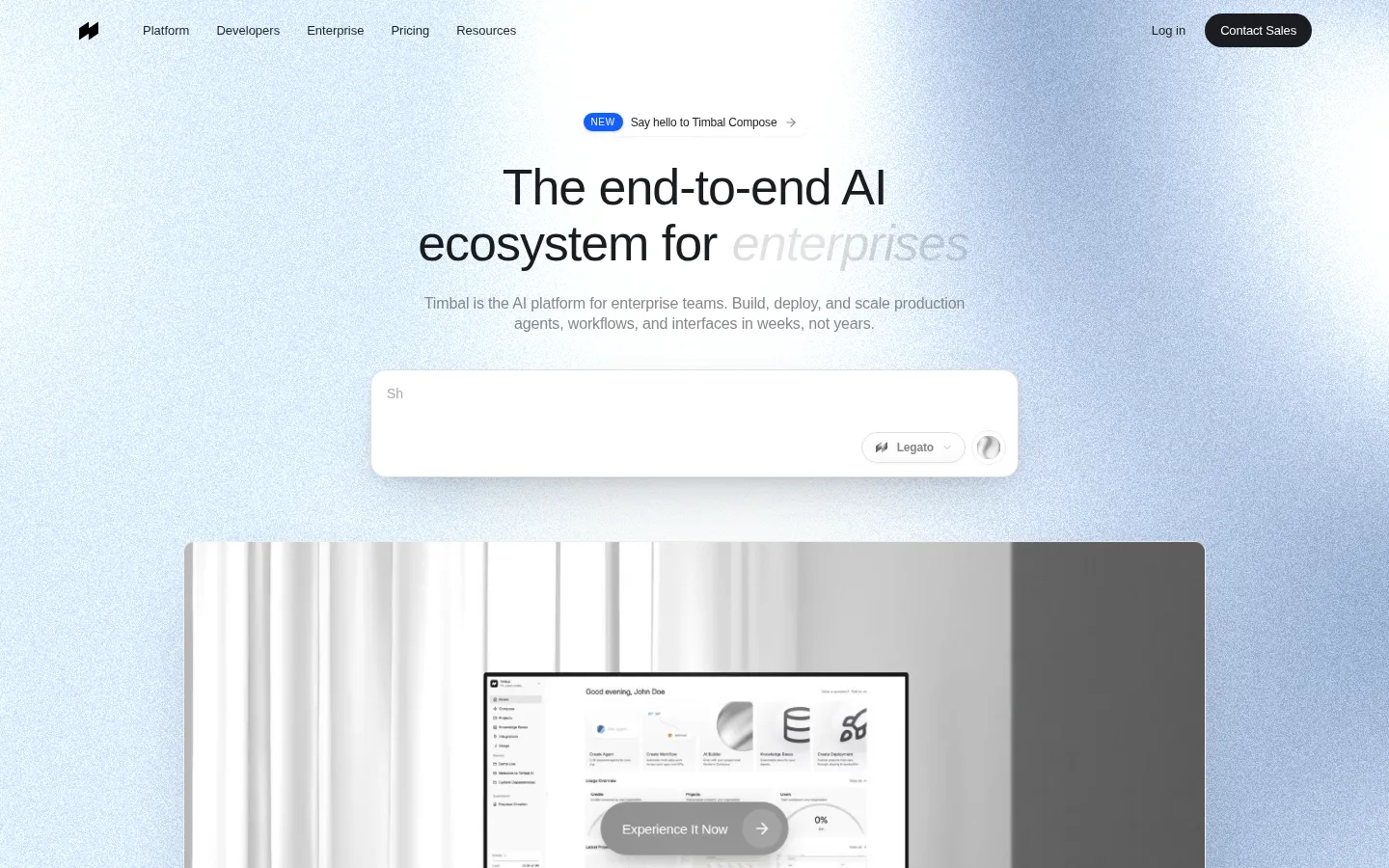
Timbal Core Features
Agent Framework
A typed Python framework plus Studio to define reasoning, tools, and memory as production-ready agents.
Workflows
Deterministic AI pipelines that chain steps and branch on logic to guarantee outcomes.
Knowledge Bases
Enterprise-grade hybrid RAG that fuses vectors, full-text search, and SQL in one engine.
100+ Integrations
Native connectors for SAP, Salesforce, Slack, Teams, Drive, and Jira, plus any MCP server.
Exportable Code
Every agent, workflow, and integration compiles to clean code you can read, run locally, and self-host.
ACE Runtime
The Action Control Engine, a behavioral proxy claimed to improve reliability and cut cost per run.
Deploy Anywhere
Run on multi-tenant SaaS, a dedicated VPC, or on-premise across AWS, Azure, and GCP.
Governance and Observability
Traces, evals, RBAC, audit logging, and SOC 2 Type II and ISO 27001 readiness.
Who is Timbal for?
Timbal targets enterprise engineering, platform, and AI teams that need to move AI from prototype to governed production. Its natural user is a software engineer or AI developer who wants a typed Python framework, SDK, CLI, and Studio to define agents, workflows, knowledge bases, and interfaces, then deploy them on any model provider without rewriting for each environment. Enterprise architects and CIO or CTO offices choose Timbal when they must run AI on their own cloud, inside a VPC, or fully on-premise while keeping control of model keys, audit trails, and data residency. Security, risk, and compliance teams are served by SOC 2 Type II and ISO 27001 readiness, GDPR alignment, EU AI Act positioning, role-based access, and exportable code that removes black-box risk. Data and platform teams use the hybrid DB engine - vectors, full-text, and SQL - for enterprise RAG, and connect to SAP, Salesforce, Slack, Teams, Drive, and Jira through 100+ native integrations or any MCP server. Product teams building customer-facing assistants and internal copilots use the interfaces layer, autogenerated APIs, and observability to ship chat, dashboards, and voice experiences from one runtime. Operations and back-office groups apply it to helpdesk assistants, meeting-notes automation, recruiting screening, and vendor risk assessment. It suits regulated industries such as retail, logistics, travel, F&B, and services, and companies consolidating a sprawl of frameworks, vector stores, workflow tools, and routing layers into one platform. Because plans start at 25 euros a month with usage and seat-based pricing, Timbal also fits smaller product teams that want enterprise-grade building blocks without an enterprise contract, while larger, regulated rollouts use custom Enterprise pricing with sovereign hosting, SLAs, and procurement support.
Timbal Use Cases
Build and ship internal copilots and customer-facing assistants
Automate document-heavy back-office and customer-care workflows
Connect agents to SAP, CRM, and knowledge bases without glue code
Deploy governed AI inside your own VPC or on-premise
Prototype agents in Studio, then promote versions across dev, stage, and prod
Create voice, chat, and dashboard interfaces for AI products
Expose any AI application as an autogenerated, live API
Replace a patchwork of AI frameworks, workflow tools, and vector stores
Timbal Pros and Cons
Pros
- A full production stack from framework to governance, replacing many disconnected tools.
- Model-agnostic design and exportable code avoid vendor lock-in and black boxes.
- Strong enterprise features: VPC and on-premise hosting, SSO and SCIM, SOC 2 Type II, and ISO 27001.
- 100+ native integrations and MCP support connect cleanly to existing systems.
- Studio plus code-based building serves both developers and less technical builders.
Cons
- No free tier is published; paid plans start at 25 euros a month with usage-based credits.
- The enterprise-grade scope may be more than small teams or solo creators actually need.
- Prices are shown in EUR and exclude taxes, so real cost varies by location and usage.
FAQ About Timbal
Timbal Pricing
Timbal has no published free tier; paid plans start at EUR 25 per month (Creator), EUR 99 per month (Pro), and EUR 337 per month (Scale) with a 17% annual discount, plus custom Enterprise pricing.
Check official pricingCreator
100K monthly credits, 1 admin user, unlimited Studio projects, custom domains; save 17% with annual billing.
Pro
500K monthly credits, unlimited knowledge bases, priority email support, and beta feature access.
Scale
2M monthly credits, 3 admin users, dedicated compute, and multi-seat access with roles.
Enterprise
Unlimited credits and admin users, SSO and SCIM, on-premise or private cloud, custom SLAs and data retention.
Timbal Alternatives
Google Antigravity
Google Antigravity is Google's agent-first development platform. It bundles Antigravity 2.0 for orchestrating parallel agents, a lightweight terminal CLI, a standalone IDE, extensions for popular editors and a Python SDK. Agents run inside Projects, report through Artifacts and can be scheduled. Individuals get a free tier with unlimited Tab completions; higher quotas need Google AI Pro or Ultra.

scvd.store
Free conformance checking for any issuer’s x402 signed offers and receipts including our competitors’ a weekly signed Bitcoin-anchored corpus.

Hypit
Hypit is an open-source video programming language and runtime for AI agents. A coding agent installs the skill, reads a reference video or a written brief, and rebuilds the shots, dialogue, B-roll, captions and effects with your material, producing many variants per run. Hosted generation runs on credit plans, and your own model keys can be used instead.