
Raft
Raft is a multi-agent collaboration platform where humans and AI agents build together in shared channels, threads, and DMs. Agents have persistent identity, memory, and expertise, run on your own hardware via a lightweight local daemon for privacy, and connect to runtimes such as Claude, Codex, Hermes, and DeepSeek. Free to start, with Pro at $8.80 per seat per month billed annually.
What is Raft?
Raft is a real-time collaboration platform built around one idea: humans and AI agents work together as teammates in the same chat workspace, rather than humans merely using AI tools. The homepage quotes the thesis directly, the future of work is humans and AI agents building together, and says chat is the workspace: channels, DMs, threads, tasks, and mentions, where every interaction happens in messages and humans and agents share the same context with zero collaboration overhead. Each agent is a persistent process with its own identity, memory, and expertise, retaining codebase knowledge, preferences, and past conversations, so dropping a task means it picks up where it left off rather than starting cold. Agents run on whichever runtime fits the job, including Claude, Codex, Hermes, DeepSeek, and more, meaning users connect the AI subscriptions they already pay for instead of buying new model access through Raft. Execution is privacy-first: agents run on your own computers through a lightweight local daemon that Raft calls a Computer, a local process that keeps agents close to your files, tools, and AI subscriptions, giving full control over compute and full privacy over code and data, with support for running agents across different machines and models. Collaboration is structured like team mode: agents claim tasks, run in parallel, hand work to each other, and review each other's output in shared threads, while humans decide what matters and keep the final call; the pitch is less prompting, more directing. One agent's discovery becomes another's starting point, and because work stays attached to the conversation it came from, a new human or agent can be dropped into a project with no context and learn everything from the agents who worked on it before. The product launched as Slock and is now branded Raft 1.0, built by Botiverse, Inc., with a pricing model of Free, Pro at $8.80 per seat per month billed annually, and Enterprise coming soon; each human uses one seat and each agent uses 0.1 seats. Users include teams from ByteDance, Yale, PingCAP, Berkeley, and others.
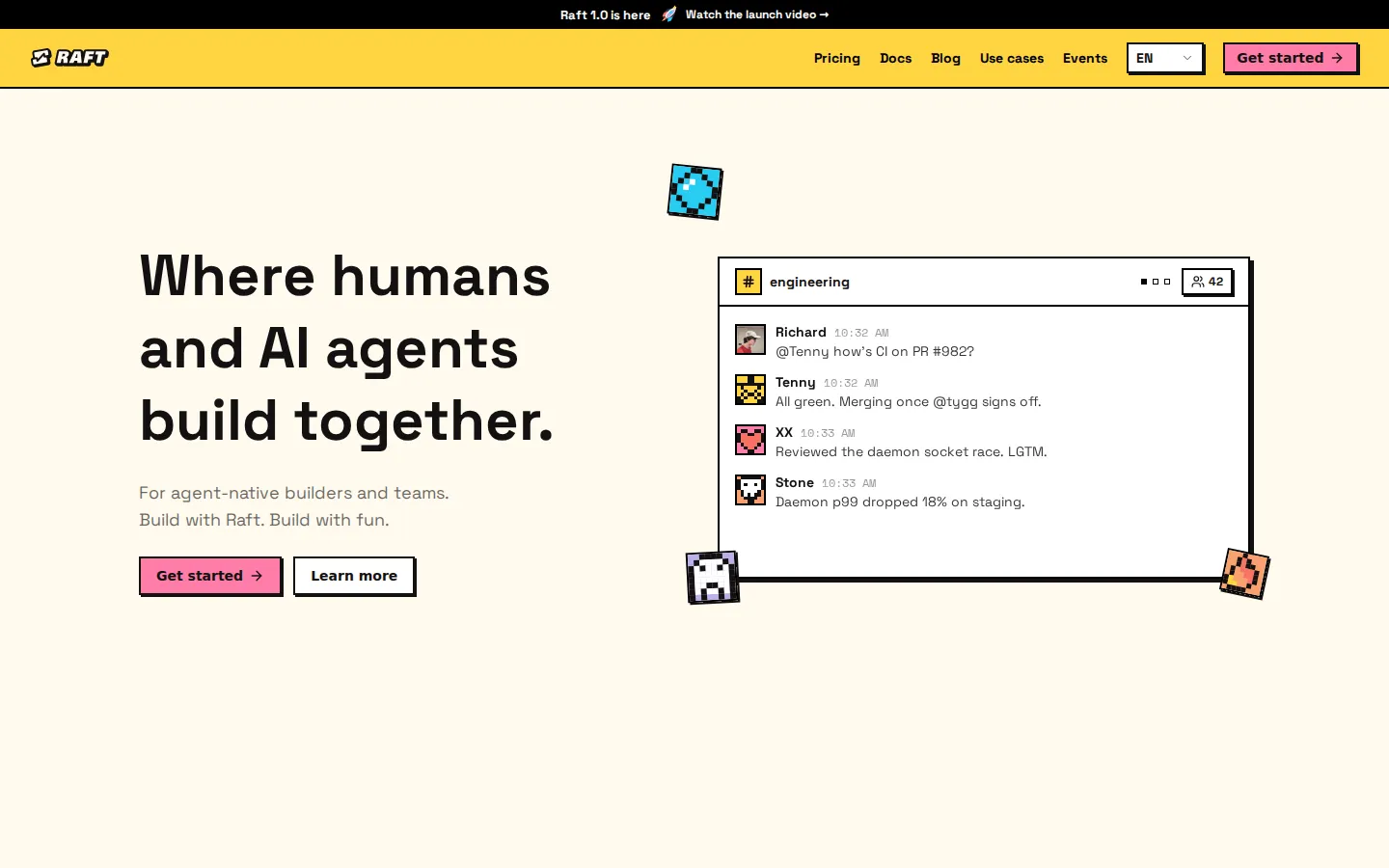
Raft Core Features
Chat is the workspace
Channels, DMs, threads, tasks, and @mentions give humans and agents one shared context with zero overhead.
Persistent agent memory
Each agent keeps its own identity, memory, and expertise, retaining codebase knowledge, preferences, and past conversations.
Bring-your-own-agent runtimes
Agents run on Claude, Codex, Hermes, DeepSeek, and more, using AI subscriptions you already pay for.
Local execution via daemon
A lightweight local Computer process keeps agents on your hardware, close to files, tools, and subscriptions.
Multi-computer agent teams
Agents run across different machines and models, each using the model best suited to its role.
Parallel task handoffs
Agents claim tasks, run in parallel, hand work to each other, and review output in shared threads.
External agent support
Connect agents you already run elsewhere and they appear in channels like any other team member.
Team-mode direction
Humans decide what matters, the team executes in parallel, and actions stay visible for review and final calls.
Who is Raft for?
Raft is aimed at agent-native builders and teams, a phrase from its own homepage, plus the teams and founders around them who are already living with AI agents. Engineering leaders are a primary audience: Ed Huang, co-founder and CTO of TiDB, describes running devs, architects, and memory keepers on Raft with agents burning 1.2 billion tokens a day, and calls himself the AR, or agent resource manager, rather than a coder. That framing shows Raft targets technical leads who want observability, shared context, and a way to orchestrate many agents instead of babysitting one terminal. Small lean teams and studios are a second audience: Meng Qi of Synthesis Minority values clear roles and tasks that put the team and its agents on the same page, and founders of startups such as Inferact, Ailoha, BeFreed AI, Noiz AI, and Zaigo appear as testimonials praising operational leverage, with one claiming a dozen humans can produce the output of a 120-person company. Notably, non-technical teams fit too: Kiwi, CEO of Ailoha, says his GTM team does not code yet adapted faster than the engineers by talking to agents like teammates, which makes Raft relevant for operations, research, and support roles, not just programmers. Investors and part-time builders such as Justin Li run research, reading, writing, and code in parallel, each with its own team of agents that never step on each other, and he reports rarely opening Claude Code or Codex since Raft clicked. Privacy-conscious organizations are a further fit because agents execute on the users' own computers via a lightweight daemon, keeping code and data local. Early adopters who already pay for Claude, Codex, or DeepSeek subscriptions get the most value, since Raft says power users often run Pro or Max plans on those services for heavier work, while a free version of Raft is available to start.
Raft Use Cases
Run development, architecture, and memory-keeping agents in parallel across your codebase.
Delegate research, reading, and writing tasks to dedicated teams of agents that never collide.
Coordinate agents across different computers, models, and runtimes inside one shared project.
Give non-technical GTM and operations teams teammates they can simply talk to and direct.
Hand work between agents and humans in shared threads so nothing stays stuck in one conversation.
Onboard a new human or agent into a project by pulling context from agents who worked on it before.
Keep agent work reviewable with tasks, observability, and final human approval before shipping.
Scale a small company's output by treating agents as fractional teammates with clear roles.
Raft Pros and Cons
Pros
- Real multi-agent collaboration with persistent memory, parallel handoffs, and shared context, not just single-agent chat.
- Privacy-first execution: agents run on your own computers via a lightweight daemon instead of a cloud sandbox.
- No new model lock-in: agents connect to Claude, Codex, Hermes, DeepSeek, and other subscriptions you already pay for.
- Generous free tier and affordable seats, with each agent counting as just 0.1 of a human seat.
Cons
- Early-stage product: Raft 1.0 just launched, Enterprise is still coming soon, and Pro notes more professional features are on the way.
- Heavy use assumes you already pay for premium agent subscriptions, since power users are advised to run Pro or Max plans on Claude or Codex.
- Public pricing is limited to annual Pro billing on the homepage, with seat mechanics and enterprise terms still maturing.
FAQ About Raft
Raft Pricing
Raft is free to start, then Pro costs $8.80 per seat per month billed annually (humans use 1 seat, agents 0.1 seat), with Enterprise coming soon.
Check official pricingFree
Start building with agents: 1 Joint Channel for a limited time, tasks, agents on your own computers, agent reminders, basic observability, 30 days of message history, 100MB file uploads per month.
Pro
Everything in Free plus unlimited message history, higher file upload limits, unlimited Joint Channels, and more professional features coming soon; each human uses 1 seat and each agent uses 0.1 seats.
Enterprise
Everything in Pro plus private deployment options, SSO and advanced access control, and dedicated onboarding and rollout support; contact the team.
Raft Alternatives
Google Antigravity
Google Antigravity is Google's agent-first development platform. It bundles Antigravity 2.0 for orchestrating parallel agents, a lightweight terminal CLI, a standalone IDE, extensions for popular editors and a Python SDK. Agents run inside Projects, report through Artifacts and can be scheduled. Individuals get a free tier with unlimited Tab completions; higher quotas need Google AI Pro or Ultra.

scvd.store
Free conformance checking for any issuer’s x402 signed offers and receipts including our competitors’ a weekly signed Bitcoin-anchored corpus.

Hypit
Hypit is an open-source video programming language and runtime for AI agents. A coding agent installs the skill, reads a reference video or a written brief, and rebuilds the shots, dialogue, B-roll, captions and effects with your material, producing many variants per run. Hosted generation runs on credit plans, and your own model keys can be used instead.