
PiAPI
PiAPI is an AI generation API platform that gives developers access to 94 multimodal models through one endpoint, a CLI, and an MCP server. It covers image, video, audio, 3D asset, and LLM generation, and integrates with Make, n8n, and Zapier for no-code automation workflows.
What is PiAPI?
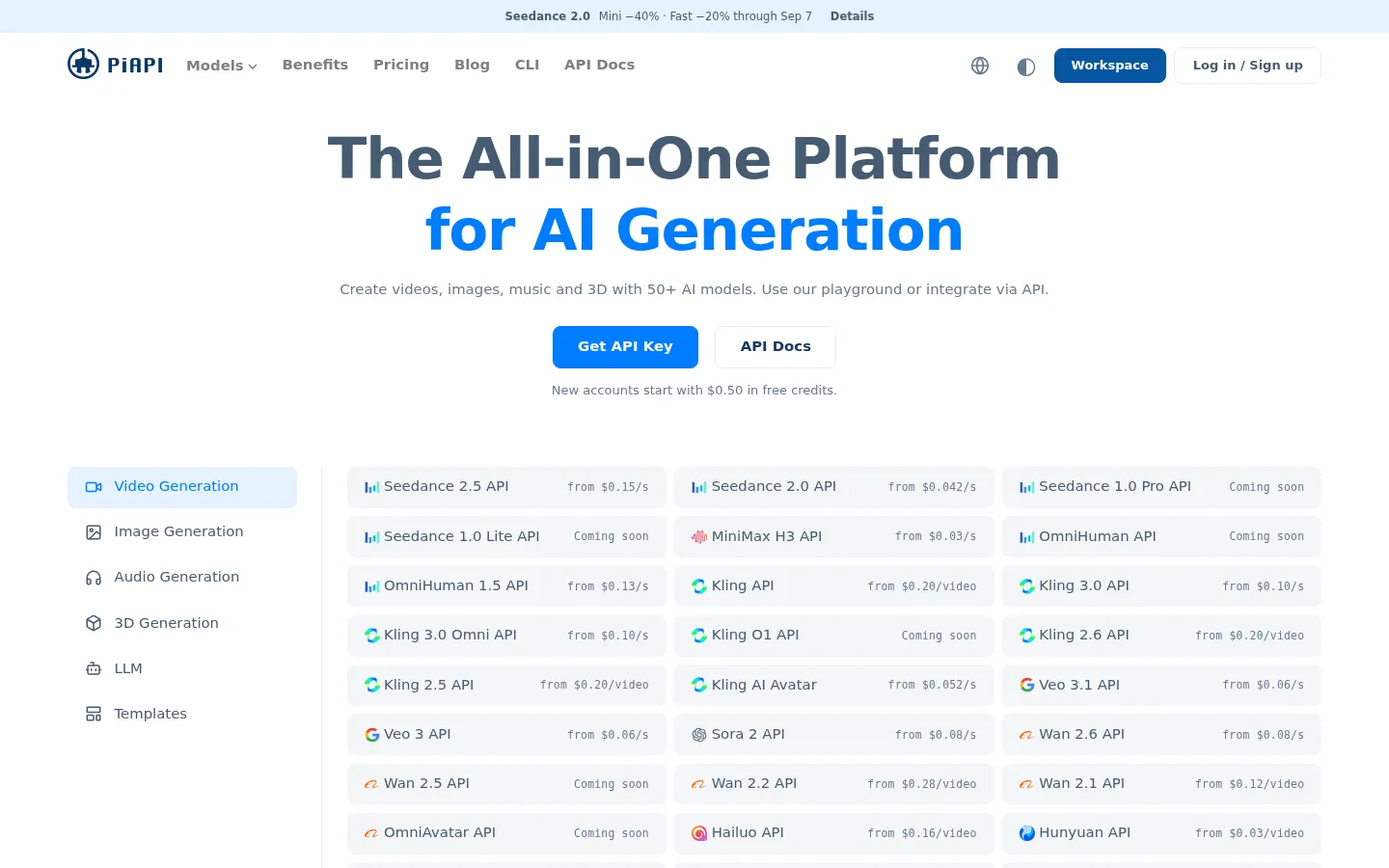
PiAPI is an all-in-one API platform for AI generation that gives developers access to 94 multimodal AI models through a single endpoint. Instead of signing up for separate providers for image generation, video generation, audio, 3D assets, and chat models, developers use PiAPI as the unified layer: one API key, one billing system, and one integration pattern for all model families. The platform explicitly notes that it does not provide Midjourney or Suno API services, recommending alternative providers for those specific models, which keeps its catalog focused on models it actually hosts. PiAPI is built for developers, AI agents, and automation workflows. It ships a CLI tool called piapi-cli that lets users generate images, videos, audio, and 3D assets, and chat with LLMs directly from the terminal, for example running a FLUX image generation with a single command or listing video models like sora2-pro, kling-3, and veo3-fast. The MCP server exposes the same models to MCP-compatible assistants and coding agents, returning structured JSON so agents can plug in without custom integration code. For no-code users, PiAPI connects to Make, n8n, and Zapier through ready-made HTTP modules and webhooks. The API supports webhooks with secrets, async task processing, and flexible payment options, and the pricing page lists subscription plans: Free, Creator at $15/month with $10 bonus credits, Pro at $60/month, and Enterprise at $100/month. Subscriptions provide platform features and rights, while actual model usage is paid through pay-as-you-go credits or Host-Your-Account seats ranging from $5 to $10 per seat per month depending on the API. The platform includes a playground, extended API access tiers, task concurrency options, invoice customization, and sub-account management for teams. Support is provided through an official Discord channel, and the company describes itself as a team of tech and creativity enthusiasts simplifying AI access for developers around the globe.
PiAPI Core Features
94 Multimodal Models
One API for image, video, audio, 3D asset, and LLM generation including FLUX, Sora 2, Kling 3, and Veo 3
PiAPI CLI
Generate and manage models from the terminal with npm-installable piapi-cli
MCP Server Support
Exposes every model to MCP-compatible assistants and coding agents with structured JSON
No-code Automation
Ready-made HTTP modules and webhooks for Make, n8n, and Zapier
Async Tasks & Webhooks
Long-running generations with webhook callbacks and secrets
Flexible Billing
Subscription plans plus pay-as-you-go credits and Host-Your-Account seats
Sub-account Management
Enterprise plan supports up to 100 sub-accounts with unified billing
Auto-failover
Automatic failover from Host-Your-Account to pay-as-you-go improves stability
Who is PiAPI for?
PiAPI is designed for developers and teams that build applications on top of generative AI models. Software developers use the unified API to add image, video, audio, and 3D generation to their products without managing multiple vendor integrations. AI agent builders use the CLI and MCP server so coding agents and MCP-compatible assistants can call any of the 94 models with structured JSON. Automation specialists connect PiAPI to Make, n8n, and Zapier to add AI generation to business workflows without writing code. Indie hackers and startup founders use the free and Creator plans to prototype AI features at low cost, then scale to Pro or Enterprise as usage grows. Mobile and web app teams use the async task processing and webhooks to handle long-running generation jobs reliably. Teams managing multiple business units use Enterprise sub-accounts and unified billing to control access and costs centrally. Creators and studios building internal tools for media production use the API to batch-generate assets for content pipelines. Organizations that want one invoice and one vendor relationship for many model families use PiAPI to consolidate their AI spend. Students and researchers building experimental AI projects also use the playground and free plan to learn model integration patterns before scaling up.
PiAPI Use Cases
Add FLUX image generation to a design app with a few lines of code
Build an AI agent that generates videos on demand through the MCP server
Automate social media asset creation in n8n with PiAPI HTTP modules
Generate 3D assets for a game prototype using the CLI
Process batch image generations asynchronously with webhook callbacks
Prototype an AI feature on the Free plan before committing to paid usage
Run a content pipeline that mixes LLM chat and video generation through one API
Manage AI generation for multiple business units with Enterprise sub-accounts
PiAPI Pros and Cons
Pros
- One API key covers 94 models across image, video, audio, 3D, and chat
- CLI and MCP support make it easy for agents and terminal workflows
- No-code integrations with Make, n8n, and Zapier lower the barrier for automation
- Free and low-cost Creator plans support prototyping
Cons
- Subscription fees and usage credits are billed separately, so costs are layered
- Does not provide Midjourney or Suno API services, which some users may expect
- Support email states that emails are not answered, pushing users to Discord
FAQ About PiAPI
PiAPI Pricing
Freemium: Free plan, Creator $15/mo (+$10 bonus credits), Pro $60/mo, Enterprise $100/mo. Model usage billed separately via pay-as-you-go credits or Host-Your-Account seats ($5-$10/seat/mo).
Check official pricingFree
Basic features, limited task processing speed, automated customer service, access to basic APIs, playground trial
Creator
Receives $10 bonus credits each cycle, unlimited task processing speed, extended API access, email or ticket support
Pro
Receives $60 bonus credits each cycle, all API task types, top priority generation, invoice customization
Enterprise
Higher task concurrency, up to 100 sub-accounts, unified billing and balance management
PiAPI Alternatives

APIMart
APIMart is a unified AI API gateway providing access to 500+ models through a single OpenAI-compatible API. It covers chat, image, video, and audio models including GPT-5, Claude, Sora 2, and Veo, with pay-as-you-go credits, health-aware routing, and savings of up to 70% for production teams.

Novita AI
Novita AI is an AI-native cloud platform that gives developers access to 200+ models through a single API, on-demand GPU cloud instances, and an agent sandbox. It suits AI engineers, startups, and enterprises that want to run LLMs, image, video, and audio models without managing infrastructure.

Inworld AI
Inworld AI provides realtime AI infrastructure for consumer-facing applications, including first-party TTS-2 and Flash text-to-speech, speech-to-text, and a router covering 220+ LLM models. It offers credit-based pricing with a free On-Demand tier and voice cloning, voice design, and realtime API access. The platform supports voice cloning, workspace management, and open-source developer projects.