
Monid
Monid is an agent-native gateway to more than 2,000 live data tools and APIs from 69+ providers, spanning web search, scraping, sales enrichment, social data and generative media. Instead of juggling dozens of accounts and keys, your agent searches the catalog in natural language, inspects each endpoint's schema, runs it, and pays for that call from one shared wallet balance.
What is Monid?
Monid is an agent-native tool marketplace and execution gateway that connects AI agents to more than 2,000 third-party data tools and APIs from 69+ providers. Rather than integrating services one by one, a developer points an agent at a single Monid integration and lets that agent find the right endpoint at runtime. The catalog covers web search and page fetch, content extraction, web scraping and browser automation, social data from Reddit, TikTok, Instagram, Facebook, YouTube, Telegram, WeChat, Weibo and Xiaohongshu, B2B sales intelligence from Apollo, Clay, ContactOut and People Data Labs, company, investor and financial data, SEO intelligence from Ahrefs, weather, automotive listings, crypto and DeFi analytics, job and real-estate data, and generative media from ElevenLabs, ByteDance Seedance and MiniMax.
The core workflow is discover, inspect, run. An agent describes a need in plain language, such as "twitter posts" or "amazon product prices", and Monid returns ranked candidate endpoints with a relevance score, a measured health status and the price of a call. The agent then inspects the chosen endpoint to read its exact input schema, including path parameters, query parameters and body fields, before executing it. Runs return a run identifier that the agent polls until completion, and the response includes the amount actually charged, so cost is visible per execution rather than hidden inside a subscription.
Billing runs through one prepaid wallet instead of per-provider subscriptions. Each endpoint is priced per call or per result, and Monid adds a 10% markup on top of the underlying provider price. Users do not need an API key for each provider, because Monid holds those keys, pools capacity across providers and exposes a unified back-pressure signal so an agent can retry the next-best provider when one is throttled. A run that fails to deliver results is not charged. Developers who prefer crypto can skip the prepaid balance and pay per run in USDC over the x402 protocol on Base or Monad, with a $0.01 minimum per run.
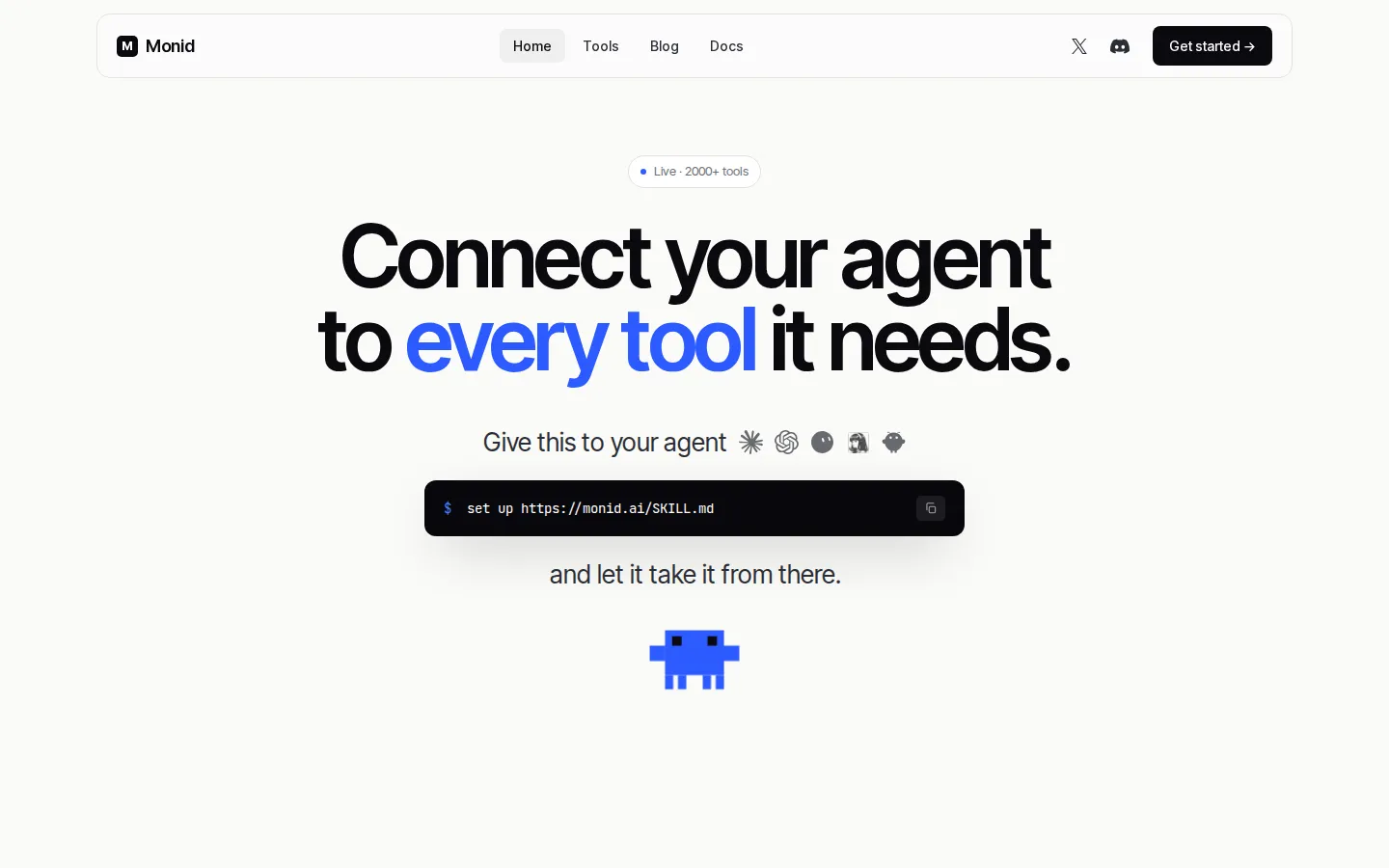
Monid ships four connection paths. One is a skill file: give an agent the line "set up https://monid.ai/SKILL.md" and it installs the Monid skill itself. Another is a remote MCP server at mcp.monid.ai/v1 that works with Claude, Codex, Cursor, OpenCode and ChatGPT connectors. The third is a Node CLI published as @monid-ai/cli, and the fourth is a plain HTTP API at api.monid.ai with discover, inspect, run, runs and wallet endpoints, plus OAuth and proxy integration options for embedding Monid in your own product. A Claude Tag access bundle is supported as well. Monid is operated by Monid Inc, a Delaware C-Corp based in San Francisco, and it runs an affiliate program paying partners 20% of referred spend for the first six months, alongside a provider program that shares revenue on listed tools.
Monid Core Features
One integration unlocks 2,000+ live data tools and APIs from 69+ providers
Natural-language discovery ranks candidate endpoints by fit, measured health and price
Schema inspection exposes path, query and body parameters so agents never guess inputs
A single prepaid wallet replaces per-provider subscriptions, quotas and separate vendor invoices
Four connection paths
SKILL.md skill file, remote MCP server, Node CLI and HTTP API
Endpoint health metrics report live status plus typical and tail run times
Runs that fail to deliver results to your agent are not charged
Optional per-run payment in USDC through the x402 protocol on Base or Monad
Who is Monid for?
Monid is built for people who ship AI agents and keep hitting the same wall: the agent needs data from a dozen different services, and every one of them wants its own account, API key, rate limit and invoice. If you build with Claude Code, Codex, Cursor, OpenCode, OpenClaw, ChatGPT connectors or a custom agent framework, Monid is designed to be the single integration that covers those gaps without a stack of vendor sign-ups. It also suits data-heavy teams that need programmatic access rather than a dashboard. Sales and GTM engineers use it to find fit-matched companies and verified work emails. SEO and content teams pull backlink indexes, keyword difficulty and AI citation counts. Market researchers scrape social platforms, review sites and marketplaces, while analysts pull company, financial, crypto and prediction-market data through the same balance. Developers who prefer the command line or raw HTTP get a CLI and an API with the same catalog and pricing. Because agents run discovery at runtime, Monid is especially useful when you cannot predict which endpoints a task will need. An agent working on open-ended research can search for the right tool mid-task instead of you hard-coding an integration per source. Teams that run many small, varied jobs benefit most, since usage is metered per call and nothing is charged for a run that returns no results. It is a less obvious fit if you already own dedicated keys and MCP servers for every service you touch, because Monid's own documentation tells agents to prefer the user's existing tools and spend Monid balance only on genuine gaps. It is also not aimed at non-technical users who want a chat interface, because setup happens in an agent, a terminal or code. Finally, API owners on the other side of the market have a place here too: Monid runs a provider program where you list your endpoint, let Monid meter and route agent traffic to it, and share the revenue.
Monid Use Cases
Scrape posts and comments from Reddit, TikTok, Instagram and YouTube for brand monitoring
Enrich B2B leads with verified work emails and firmographics from Apollo and Clay
Track a domain's backlinks, keyword difficulty and AI citation counts for SEO
Extract clean markdown or schema-shaped JSON from any page before writing a scraper
Summarize customer sentiment from Amazon, Trustpilot, Capterra and Clutch review data
Generate voiceovers, images and short promo videos for creative production agents
Pull crypto, DeFi, equities and prediction-market data for research workflows
Place an approved agent phone inquiry and return the call transcript
Monid Pros and Cons
Pros
- No per-provider API keys, accounts or invoices, because one balance covers the whole catalog
- Agents find tools at runtime, so you never pre-load hundreds of endpoint schemas into context
- Per-call pricing is shown consistently in discover, inspect and run responses
- Failed runs are not billed, and the documentation states billing errors are refunded on request
- Skill, MCP, CLI and HTTP API paths mean it fits almost any existing agent stack
Cons
- There is no published pricing page, so you must query the catalog to see individual endpoint rates
- A 10% platform markup is added on top of every underlying provider price
- Time-billed metered endpoints are not available through the x402 crypto payment route
FAQ About Monid
Monid Pricing
Monid is pay-as-you-go with no subscriptions, contracts or minimums. Each endpoint is priced per call or per result, and Monid adds 10% on top of the underlying provider price; prices appear in discover, inspect and run responses. New workspaces start with $1 in free credit, failed runs that deliver no results are not billed, and developers can instead pay per run in USDC over x402 with a $0.01 minimum.
Check official pricingFree credit
Every new workspace starts with $1 in free credit to trial discovery, inspection and endpoint runs before topping up the prepaid wallet.
Pay as you go
Prepaid wallet billed per endpoint execution or per result returned, plus a 10% Monid markup on the provider price. No subscription, no minimum spend.
x402 crypto payment
Skip the prepaid balance and pay on-chain per run in USDC on Base or Monad using the x402 protocol. Excludes time-billed metered endpoints; an API key is still needed for discovery.
Monid Alternatives

scvd.store
Free conformance checking for any issuer’s x402 signed offers and receipts including our competitors’ a weekly signed Bitcoin-anchored corpus.

Hypit
Hypit is an open-source video programming language and runtime for AI agents. A coding agent installs the skill, reads a reference video or a written brief, and rebuilds the shots, dialogue, B-roll, captions and effects with your material, producing many variants per run. Hosted generation runs on credit plans, and your own model keys can be used instead.

T3 Code
T3 Code is an open-source control plane for coding agents. It runs Claude Code, Codex, Antigravity, OpenCode, Cursor and Grok from one desktop app, keeps every agent thread on its own Git branch, and commits, pushes and opens a pull request with one button. iOS and Android apps steer the same work remotely. The app is free and MIT licensed; you bring your own agent subscriptions.