
Kimi
Kimi is Moonshot AI's flagship AI assistant, combining a powerful chat model with agentic tools for coding and knowledge work. Users can chat with the K3 and K2.6 models, run deep research, generate documents, slides, websites, and spreadsheets, deploy agents with Kimi Swarm, and write code with Kimi Code and Kimi Claw. It serves students, researchers, developers, and professionals.
What is Kimi?
Kimi is an AI assistant developed by Moonshot AI, designed for agentic coding and knowledge work on top of a strong chat foundation. Kimi's chat interface lets users ask questions, analyze files, and reason over long documents, with the K2.6 model free to use in chat and the newer K3 flagship powering advanced tasks. Beyond conversation, Kimi ships a full suite of agentic tools: Deep Research for multi-step web research, Docs for document creation and editing, Slides for presentation generation, Websites for building pages from prompts, Sheets for spreadsheet work, and Design for visual creation. Developers can use Kimi Code, an agentic coding environment that writes, runs, and iterates on code, and Kimi Claw, a cloud-hosted agent that operates browsers, executes code, and calls tools through OpenClaw deployments. Kimi Swarm coordinates multiple sub-agents to parallelize complex tasks, while Projects organize chats and files into workspaces with shared knowledge. The platform supports plugins, scheduled tasks, widgets, and goal mode for recurring automation, and a professional database adds structured data lookup capabilities. Membership tiers scale agent credits, concurrent tasks, project storage, and features such as long-context K3 chat, group chat with Claw, and larger sub-agent swarms. Kimi is available on the web, iOS, Android, macOS, and Windows, with a free tier that covers everyday chat and a subscription model for heavier agentic usage. The product is aimed at knowledge workers who want one assistant that can research, write, design, and code, replacing a stack of separate tools with a single conversational workspace. Kimi's agentic design also extends to the browser and mobile apps, where the same conversation history, projects, and plugin configurations sync across devices, so users can start a research task on the web and continue it on their phone. The platform supports multiple languages and is used internationally, with Moonshot AI operating the service under Chinese regulatory filings while serving global users through kimi.com. Kimi's credit system is shared across features, meaning users can allocate their monthly agent credits between coding, research, document generation, and swarm tasks as needs shift. For teams, shared projects and group chat with Claw allow collaborative agent sessions, while goal mode and scheduled tasks turn recurring workflows into set-and-forget automations. The roadmap continues to add agentic capabilities, positioning Kimi as an all-in-one productivity layer that competes with both chatbot subscriptions and standalone agentic coding tools.
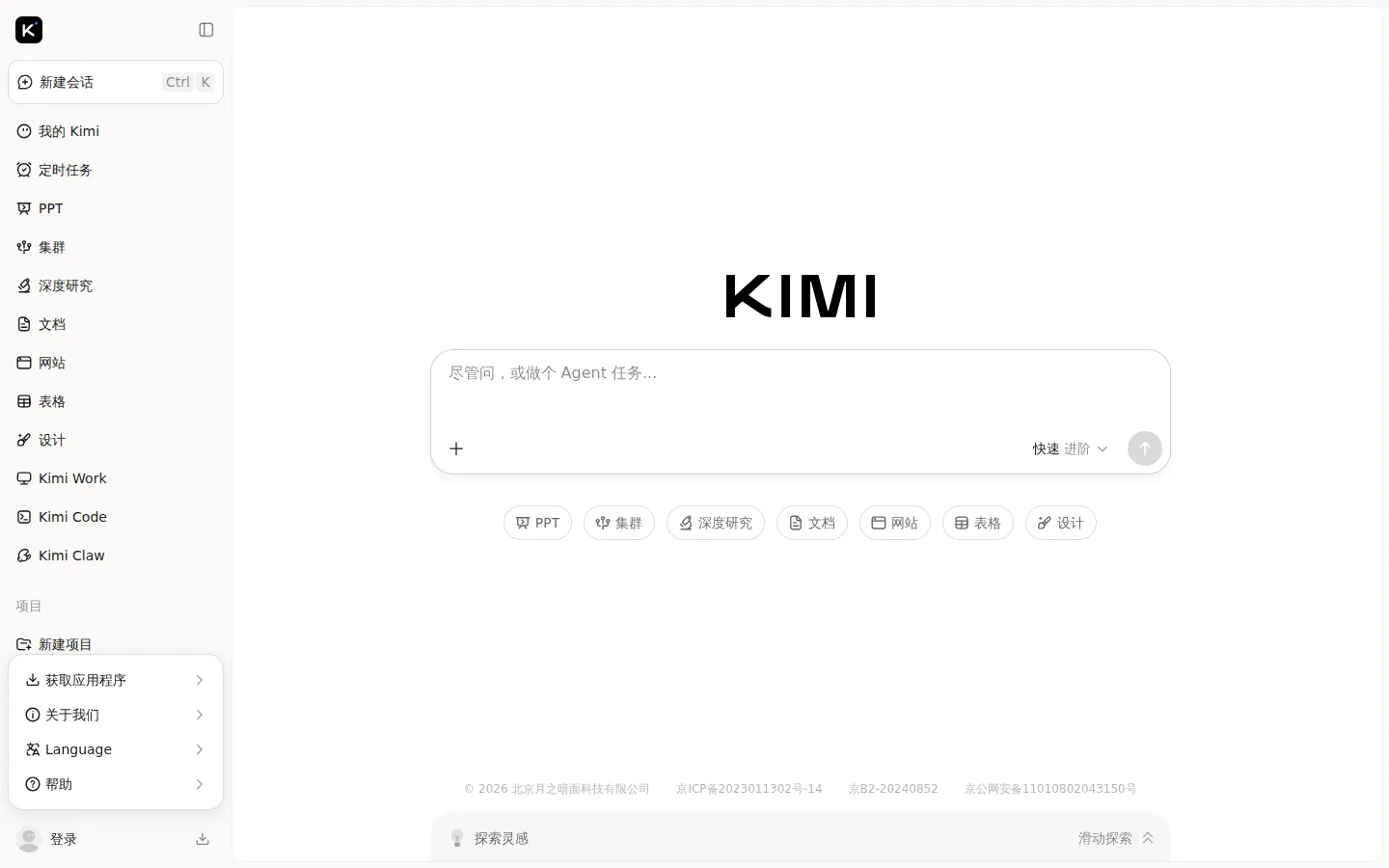
Kimi Core Features
Agentic chat
Chat with the K3 and K2.6 models, analyze files, and reason over up to 1M tokens on higher tiers.
Deep Research
Run multi-step web research that gathers, cross-checks, and summarizes sources automatically.
Kimi Code
Agentic coding environment that writes, runs, and iterates on code until the task is done.
Kimi Claw
Cloud-hosted agent that controls a browser, executes code, and calls tools through OpenClaw.
Kimi Swarm
Coordinate multiple sub-agents to parallelize research, writing, and complex multi-step work.
Productivity suite
Generate Docs, Slides, Websites, and Sheets directly from prompts and conversations.
Projects & plugins
Organize chats and files into workspaces, extend behavior with 15+ plugin types.
Scheduled tasks & goal mode
Automate recurring jobs and set long-running goals with self-evolving skills.
Who is Kimi for?
Kimi is built for knowledge workers and developers who want a single AI workspace for research, writing, and coding. Software developers use Kimi Code and Kimi Claw to build and debug applications with an agent that can run code and browse the web. Product managers and analysts use Deep Research and Sheets to gather market data, compare options, and build reports. Students and academics use chat and Docs for literature review, essay drafting, and long-document analysis with the large context window. Marketers and content teams generate slides, websites, and design assets from briefs. Founders and startup teams prototype websites and internal tools quickly with the agentic builder. Researchers rely on the professional database and swarm mode to parallelize literature and data collection. Operations staff schedule recurring tasks with scheduled tasks and widgets. Designers use the Design tool for visual exploration, and writers use Docs for drafting and editing long-form content. Teams benefit from Projects workspaces, shared chat history, and group chat with Claw for collaborative agent sessions. Kimi also suits power users who juggle multiple AI tools and want one subscription covering chat, research, document creation, and coding. The free tier serves casual users, while professionals who need agent credits, priority queues, and long-context K3 access choose paid memberships. Data analysts use Sheets and the professional database to interrogate structured data conversationally. Consultants and advisors draft client deliverables with Deep Research and Docs. Technical writers and documentation teams generate and update documentation with Kimi Code. HR and operations professionals automate onboarding materials and internal FAQs with scheduled tasks. Non-technical team leads who want AI assistance without learning prompts benefit from the guided tools like Slides and Websites. Kimi's tiered membership means casual users pay nothing while heavy agentic users can scale to the Vivace tier, making it a versatile choice across individual and team contexts.
Kimi Use Cases
Research a market or academic topic with multi-step Deep Research and cite the sources found.
Build a full-stack app by describing requirements to Kimi Code and letting the agent iterate.
Generate a presentation deck from an outline with the Slides tool in minutes.
Create a landing page or internal tool from a text brief with the Websites agent.
Analyze spreadsheets and build reports by asking questions in natural language.
Draft and edit long documents with the large-context chat and Docs workspace.
Automate recurring tasks like daily briefings or report generation with scheduled tasks.
Kimi Pros and Cons
Pros
- One subscription covers chat, research, document creation, design, and coding agents.
- K3 and K2.6 models deliver strong reasoning with a very large context window.
- Kimi Swarm and Claw enable true multi-agent and browser automation workflows.
- Free tier keeps K2.6 chat accessible, with annual billing saving up to $480/year.
Cons
- Agent credits are metered, and heavy coding or swarm usage consumes them quickly.
- Some advanced features like Claw and long-context chat require higher tiers.
- The platform's breadth means a learning curve to use every tool effectively.
FAQ About Kimi
Kimi Pricing
Freemium. Free tier (K2.6 chat free). Paid: Moderato $19/mo ($15 annual), Allegretto $39/mo ($31 annual), Allegro $99/mo ($79 annual), Vivace $199/mo ($159 annual). Annual saves up to $480/year.
Check official pricingModerato
60 agent credits, 2 concurrent tasks, scheduled tasks, projects, plugins, Agent Swarm, Kimi Code; annual $15/mo
Allegretto
150 agent credits, Kimi Claw, Goal Mode, group chat with Claw, 5,000 professional database calls; annual $31/mo
Allegro
360 agent credits, 4 concurrent tasks, K3 1M-token chat, 100 projects, 12,000 database calls; annual $79/mo
Vivace
720 agent credits, 25 scheduled tasks, 24,000 database calls, top-tier agent usage; annual $159/mo
Kimi Alternatives

Tasklet
Tasklet is an AI agents platform that lets you delegate real work to agents connected to your tools, automating workflows around the clock with no developer required. Agents draft emails, summarize Slack, manage calendars, run automations, and learn over time, with thousands of built-in integrations, direct API access, and MCP support. Free to start with 300 bonus credits daily, SOC 2 compliant, with paid plans from $25 per month.

Abacus.AI
Abacus.AI is an enterprise-grade agentic AI platform that combines autonomous AI agents, ChatLLM access to frontier models, deep research, and workflow automation. Teams use it to build production apps, automate Jira and CRM work, run agent swarms, and connect to hundreds of models through a cache-aware API called RouteLLM.

Poe
Poe is a multi-model AI chat platform by Quora that aggregates GPT-5.6, Claude, Gemini, Grok, Kimi, and thousands of other bots behind one interface. Users chat privately or in group chats, browse a leaderboard, and subscribe for more messages and access to the best models. It is available on web, iOS, Android, macOS, and Windows.