
Hedra
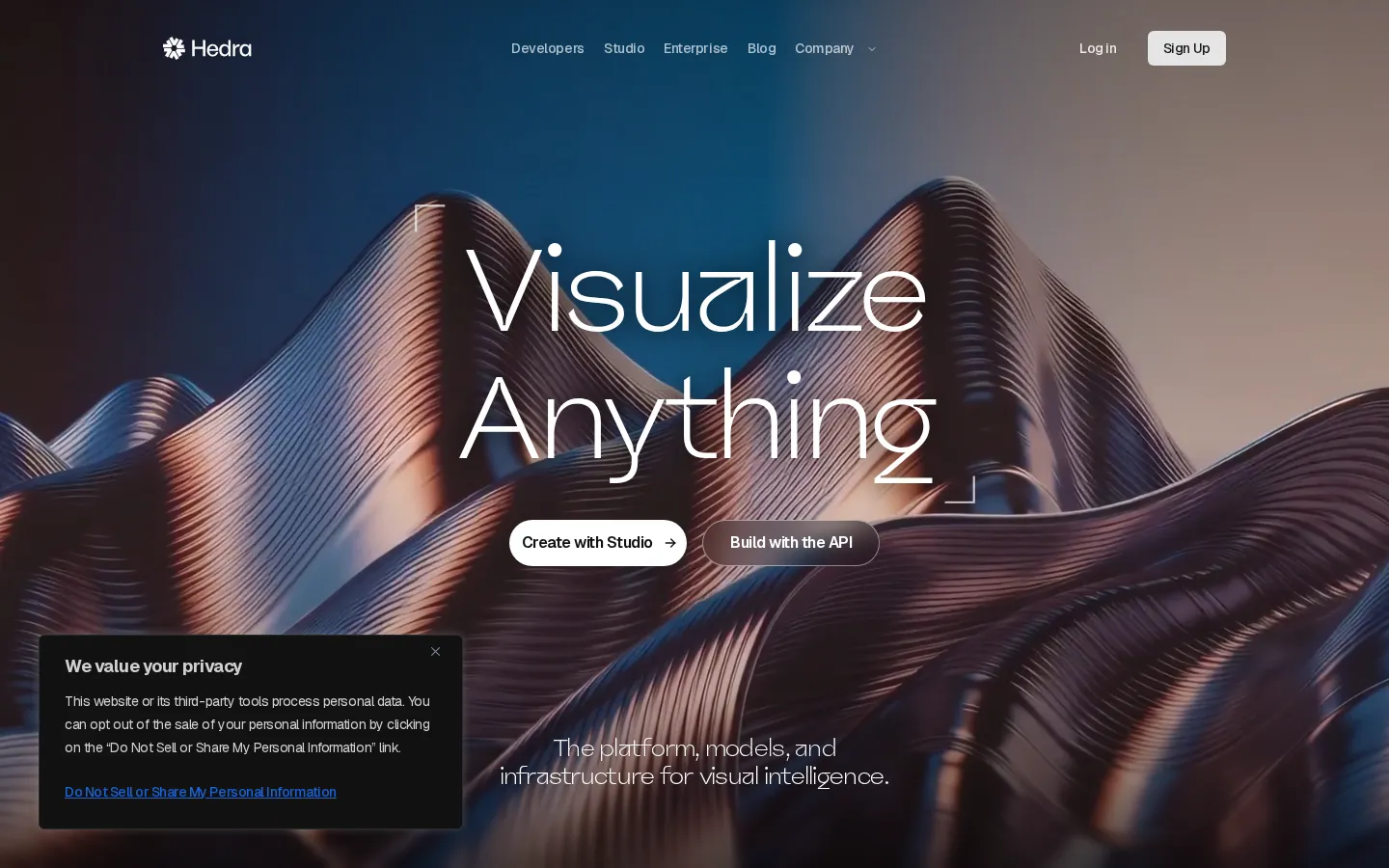
Hedra is a visual intelligence platform for AI video and character generation. Its Creative Studio agent, multiplayer canvas and hosted inference bring together video, image, speech, music and avatar models, while developers reach the same models through an API. Individuals, studios and businesses use Hedra to create talking characters, edit and export AI-generated video, and run diffusion workloads on their own clusters.
What is Hedra?
Hedra is a visual intelligence company and AI video generation platform built around three things: an agent-led Creative Studio, a developer API and a sovereign inference stack for its own visual models. The site says Hedra builds models that generate, perceive and predict the visual world, plus the platform that runs them in production. Individuals, developers and businesses use it to turn prompts, images and audio into finished video, characters and campaigns.
Creative Studio is the main workspace: an agent for creative productivity that strategizes, ideates, plans and executes creative work with skills, MCP connections and your own data and tools, so it learns how your team works. Work happens on a multiplayer infinite canvas, which Hedra calls Spaces, where every asset, every version and every teammate can be present in real time. The same agent chooses between hosted models and knows how to get the most from each: Hedra's own Avatar models alongside video, image, speech and music models such as Kling 2.6 Pro and Flux 1.1 Ultra.
For developers, Hedra exposes those models through an API, documented with a quickstart and endpoint patterns such as POST /v3/models/{id}, so product teams can add video, image, speech, music and avatar generation without building inference infrastructure themselves. Larger organisations can go further with Hedra Inference, a managed diffusion stack that runs any model on any silicon on their own cluster, and with Enterprise deployments that add private hosting, single sign-on, teams and management, legal and security review, forward deployed engineers, a dedicated account manager and support on Slack.
The company also publishes research from its lab, including World Action Models that learn the dynamics of the physical world from raw sensor streams, and it offers services around pretraining, synthetic and real-world data collection, post-training of foundation models and deployment on edge, cluster or hybrid fleets.
Pricing starts with a free tier for individuals, since the pricing page invites people to start free and upgrade anytime, and the paid plans are measured in monthly credits: Basic at $20 for 2,000 credits, Pro at $50 for 7,200, Teams at $75 for 14,400 and Ultra at $100 for 18,000 credits, all with commercial use and faster generation on higher tiers. Hedra says over 20 million users, developers and businesses have joined, and that 125k+ businesses have used its inference and infrastructure.
Hedra Core Features
Creative Studio agent
An agent that strategizes, ideates, plans and executes creative work while learning your data, tools and brand.
Multiplayer infinite canvas
Spaces bring every asset, every version and every teammate onto one real-time canvas.
Hedra Avatar models
Generate talking characters, presenters and personas from prompts, images and audio on Hedra's own models.
All the models in one place
Hosted video, image, speech and music models including Kling 2.6 Pro and Flux 1.1 Ultra.
Developer API
Documented endpoints such as POST /v3/models/{id} add generation to your own product without owning infrastructure.
Sovereign inference
Run managed diffusion of video, image and audio models on your own cluster, any model on any silicon.
Enterprise controls
Private deployments, single sign-on, legal and security review, dedicated engineers and Slack support.
Research lab services
Pretraining of world models, synthetic and real-world data collection, post-training and edge deployment.
Who is Hedra for?
Hedra targets several distinct groups rather than one general audience. The clearest fit is short-form and social creators who need footage of a person speaking, moving or performing without booking a shoot: they can generate talking characters and avatars and iterate on hooks, scripts and versions quickly. Independent filmmakers, motion designers and video editors make up a second group. For them the value is a multiplayer canvas, hosted state-of-the-art models for video, image, speech and music, and an agent that helps plan and execute multi-part work, all in one browser workspace where assets and versions stay together. Marketing teams and agencies use Hedra to produce campaign assets at volume, including localised versions of the same concept, and to keep brand material, reusable skills and connected tools close to the agent that generates the work. Because that material stays attached to the agent, repeat campaigns, localised variants and client revisions can stay consistent across a whole roster. Developers and product teams building their own applications are a fourth audience. The API gives them the same models and inference infrastructure through a documented endpoint, which suits startups that want video, image, audio or avatar features without owning GPUs. Platform teams with throughput, privacy or compliance constraints are pointed instead to Hedra Inference and Enterprise. Larger businesses and enterprises are served by Teams, Enterprise and Hedra Inference: private deployments, single sign-on, security and legal review, dedicated engineers and the option to run managed diffusion on their own cluster for privacy, cost or compliance reasons. Finally, research and robotics groups appear throughout the site: World Action Models, published papers and services for pretraining, synthetic data collection, post-training and deployment point to teams working on embodied AI and world models rather than on marketing video alone.
Hedra Use Cases
Generate a talking presenter video from a script, a photo and a voice track.
Produce character-driven clips for social campaigns instead of booking actors and studios.
Turn product photos into short promotional videos for paid and organic channels.
Edit, export and share AI-generated video components from one browser workspace.
Add avatar, image, music or video generation to a SaaS product through the Hedra API.
Plan and storyboard a multi-part campaign with your team on a shared canvas.
Localise one campaign concept into several markets, languages and presenter looks.
Run diffusion workloads on your own cluster for privacy, cost or compliance reasons.
Hedra Pros and Cons
Pros
- A free tier that lets individuals start generating before paying, with paid plans from $20 per month.
- Hedra's own Avatar models sit alongside third-party video, image, speech and music models behind one account and one API.
- A documented developer API plus managed diffusion on your own cluster, which suits both small product teams and larger enterprises.
- Commercial use is listed on every paid individual and team plan, so outputs can be used in client and campaign work.
- Enterprise adds SSO, private deployments, security review, forward deployed engineers and a dedicated account manager.
Cons
- Paid plans are billed monthly only, and no annual or discounted billing option is shown on the pricing page.
- Generation speed and credit cost vary by tier and model, and the Basic plan is explicitly described as slower.
- The free tier's credit allowance and feature limits are not published on the pricing page, so upgrades are hard to compare upfront.
FAQ About Hedra
Hedra Pricing
Hedra is freemium: a free tier to start, then monthly credit plans at Basic $20 (2,000 credits), Pro $50 (7,200), Teams $75 (14,400) and Ultra $100 (18,000, allowances up to 57,600), plus custom Enterprise; billing is shown as monthly only, with no annual discount published.
Check official pricingFree
Free starting tier. The pricing page invites users to start free and upgrade anytime; the credit allowance and feature limits are not published.
Basic
2,000 credits per month, slower generations and commercial use. Billed monthly for individuals.
Pro
7,200 credits per month, faster generation and commercial use. Billed monthly for individuals.
Ultra
18,000 credits per month with allowances up to 57,600, fastest generation, commercial use and Teams plan access.
Teams
14,400 credits per month for businesses, with fastest generation, commercial use and Teams plan access.
Enterprise
Custom credit volume for enterprises, with private deployments, SSO, security review, forward deployed engineers, a dedicated account manager and Slack support.
Hedra Alternatives
Sartoris
Sartoris is a browser-based AI creative studio that generates premium still images and cinematic video from text prompts, with optional start and end frames plus image, video, and audio references. It runs on purchased credits rather than a subscription, keeps one library for both media types, and deletes finished generations twelve hours after they are created.

Reelina AI
Reelina AI is a web studio for generating video, images, voice and music with several hundred third-party and in-house models on a single coin balance. Weekly and monthly plans include coins that never expire, and coin packs can be added at any time. Generation costs appear before you run anything, so you can compare models without separate subscriptions.
Kenerate AI
An online AI creative studio for generating videos, images, voiceovers, and music from prompts or images.